from Danny Schindler. Franziska Carstensen and Viktoria Hinze
DOI: 10.36206/BP2025.03
(1) At national, European and global level, there are many forms of interparliamentary cooperation between parliamentary presidents that go largely unnoticed by the public.
(2) The Conference of Presidents of the European Parliament (COREPER-EU) met for the first time in 1963. It has met regularly at least once a year since 1975.
(3) The organisational consolidation of the JPC-EU is exemplified by the publication of programme procedures and final communiqués. The adoption and revision of formal procedural guidelines (Stockholm Guidelines) represent an organisational milestone.
(4) The conference deliberations cover a wide range of topics, including issues that are highly controversial at national level.
(5) The focus is on the (further) development of parliamentary cooperation and on dealing with current and general challenges for parliamentary institutions.
In the structure of the European Union, the European Parliament is the only directly elected institution. However, it is not the only parliamentary actor at European level. In recent decades, there have been numerous efforts to involve the parliaments of the Member States (at national and regional level) more closely in the structures and decisions of the EU. One of the earliest institutions in this respect was the Conference of Presidents of the European Parliament (JPC-EU), which met for the first time in Rome in 1963; however, regular meetings did not begin until 1975. Another example is the Conference of European Affairs Committees of National Parliaments (COSAC), which was established in 1989. The Treaties of Amsterdam (1999) and Lisbon (2009) in particular have led to a deepening of parliamentary cooperation.
As a result of the Treaty of Lisbon, which emphasises the role of national parliaments in the EU and enables parliaments to review subsidiarity[1], For example, the following bodies were created: Interparliamentary Conference on Stability, Economic Policy Coordination and Governance in the European Union and Interparliamentary Conference on the Common Foreign and Security Policy and the Common Security and Defence Policy. Both forums, each consisting of members of parliament from the Member States, were set up by the EU Conference of Presidents. In addition, as a result of the Treaty of Lisbon, it has become established for the six-monthly rotating presidencies of individual EU Member States that these are accompanied by a so-called parliamentary dimension, which is understood to mean a variety of meetings of members of parliament from the Member States, including in the aforementioned bodies, organised by the respective presidency parliament.[2]
Of these forms of interparliamentary cooperation, the Conference of Presidents of the European Parliament will take centre stage here, as it is one of the oldest cooperation institutions within the EU.[3] It is therefore suitable for analysing how such a body has developed and consolidated structurally. At the same time, the thematic development should be of interest - in the form of the content-related topics to which the conference has turned its attention and also with regard to institutional self-reflection. In order to analyse these aspects, the final documents of the individual meetings and regulations that have been adopted over time will be examined.
In the cosmos of possible interparliamentary cooperation, the PKK-EU is one of the conferences in which the highest-ranking representatives of parliaments come together to exchange experiences, coordinate their work and strengthen their own institutions. This type of presidential conference is therefore not limited to the European Union; it exists at global level, for example, with the World Conference of Presidents of Parliaments, which met for the sixth time in 2025, or for second chambers with the Association of European Senates, which met between 2000 and 2019 (see Table 1). Within the EU, the Conference of European Regional Legislative Assemblies (CALRE) is another conference of presidents that brings together the chairs of sub-national parliaments with legislative powers. A distinction must be made between these and the parliamentary assemblies in which members of the participating parliaments come together[4], to discuss specific topics and problems of a geographical region. One example of this is the Baltic Sea Parliamentary Conference, which brings together representatives from national and sub-national parliaments of the countries bordering the Baltic Sea.[5]
| Name | Geographical region | Level; type of parliaments* |
| World Conference of Presidents of Parliaments | World | national parliaments; if bicameral: first and second chambers |
| Conference of the Presidents of the G7 Parliaments | G7 | national parliaments; first chambers |
| Conference of the Presidents of the Parliaments of the Member States of the Council of Europe (Council of Europe PPC) | Europe | national parliaments; if bicameral: first and second chambers |
| Conference of Presidents of the European Parliament (PPK-EU) | EU | national parliaments; if bicameral: first and second chambers |
| Association of European Senates (AES) | Europe | national parliaments; second chambers |
| Conference of German-speaking Speakers of Parliament | Western and Central Europe | national parliaments; first chamber or unicameral |
| Conference of European Regional Legislative Assemblies (CALRE) | EU | subnational parliaments |
| European Conference of the Conference of State Parliament Presidents | Western and Central Europe | subnational parliaments; second chambers |
| Conference of State Parliament Presidents | Germany | subnational parliaments |
* It is common for individual other parliamentary institutions to be present at the conferences, such as the President of the European Parliament at the JPC-EU; these possible additional members are not listed in this table.
Source: Own compilation.
The history of the Conference of Presidents of Parliament can be roughly divided into four phases[7]Before 1975, in the first phase, there were only two ad hoc meetings. The first such meeting in Rome in January 1963 was attended by the President of the European Parliament[8] and his ten counterparts from the national parliaments of the six founding states of the European Community: for Belgium, Italy and the Netherlands, representatives of both chambers of parliament took part, whereas for the bicameral systems of Germany and France, only the representatives of one chamber (Bundestag and Sénat respectively) attended; they were joined by the presidents of the unicameral systems of Denmark and Luxembourg. A second conference did not take place until ten years later, in January 1973.
In 1975, the transition was made to regular and annual meetings. This time pattern has been maintained to this day. Meetings were only cancelled in 1979 (presumably due to the European Parliament elections) and 2020 (due to the coronavirus pandemic). In some cases, the parliamentary leaders formally met twice in one year, for example in 1975 (in Paris and Rome) or 1992 (both in Strasbourg, once on the occasion of the signing of the Maastricht Treaty). For the 1990s, the IPEX (InterParliamentary EU Information Exchange) platform also reports occasional informal meetings. However, it remains unclear what exactly - their convening at short notice or a lack of publicity? - characterised their informal nature.
The second phase, dating from 1975 to 1978, is characterised not only by the beginning of regularity. In 1975, at the meeting in Rome in September, membership was extended from the states of the EC to the states of the Council of Europe. In addition, the representatives of two supranational parliaments - the Parliamentary Assembly of the Council of Europe and, in 1976, the Assembly of the Western European Union - were added. This led, for example, to the participation of parliamentary presidents from Austria (not a member of the EC at the time), Switzerland and Turkey at the 1976 meeting in Bonn.
The third phase (1980 to 1988) brought with it a differentiation of the conference format, which was linked to the direct election of the European Parliament introduced in 1979. The abolition of the compulsory dual membership of MEPs, which accompanied the direct election, also had to be taken into account structurally in the relationship between the EP and the national parliaments of the EC. At France's suggestion, therefore, conferences at Council of Europe level („major conferences“) alternated with those at EC level („minor conferences“), usually on an annual basis.[9] This phase also saw the first participation of parliamentary leaders with observer status (in 1982 and 1984, for example, Finland, which only joined the Council of Europe in 1989 and the EU in 1995).
The fourth phase, which continues to this day, was heralded by the conference decision in 1999 to hold annual meetings at EU level from then on, i.e. in the former „small“ format. The JPC-EU thus developed into an „autonomous forum of cooperation“ and reaffirmed its „general competence of coordination and supervision of the interparliamentary cooperation in the EU“[10]. Over the course of time, the EU enlargement rounds also played a significant role in terms of numbers: the meeting of eleven people in 1963, for example, became a conference with 49 people in Slovakia in 2017.
The following analysis is based on the documents available in the IPEX system. It should be noted that the scope of these documents varies (especially in the early years, they are short documents) and that no conference transcripts exist for a few years (see Figure 1).[11] In this respect, no claim to completeness can be made with regard to the contents of the conference. However, the document analysis is certainly suitable for highlighting the organisational development of the PKK-EU. In the light of its historical origins, this development can also be generally understood as a process of institutionalisation, defined by Huntington as a „process by which organisations acquire value and stability“[12].
A formalisation trend can initially be observed with regard to the framework and external communication, specifically in the publication of the agenda and possible final communiqués. It is important to note that the IPEX website was created in 2005 with the aim of collecting all relevant documents in one place. If one takes the publications there, which were also made retrospectively, as a yardstick, a detailed programme schedule did not play a major role in the early years or was not communicated to the outside world; for many conferences in the 1980s and 1990s there was also no final document. It is also striking that there are no conference documents in the IPEX system for the period from 1981 to 1985. This was partly due to the differentiation of the conference format, because at least at „large“ conferences, final documents were initially not produced.[13] It may also be significant that the drafting of a joint final communiqué requires a certain degree of agreement. Since 1997, the existence of both types of document has been the rule, although no final text is available for 2020 due to the coronavirus-related cancellation of the meeting. The self-imposed, rules of procedure-like guidelines of the JPC-EU from 2010 (so-called Stockholm Guidelines, see below) now stipulate that the final communiqués must be published.
Over time, a step towards organisational consolidation can therefore be observed, as a certain routinisation of the framework and external communication took place. Even if it was only a matter of publishing the relevant documents, i.e. they may have already been available internally (unpublished) beforehand, it is possible to speak of a contribution to institutionalisation: Institutionalisation ultimately also includes the fact that an organisational structure „is reified in the public mind“ - regardless of who is in charge of an organisation.[14] It is therefore not only internal developments within the organisation that are important, but also the public impact of an organisation, which is not least aimed at gaining recognition and support in the political environment. The publication of programmes and final communiqués certainly contributes to the publicity of the PPK-EU - at least on the supply side.
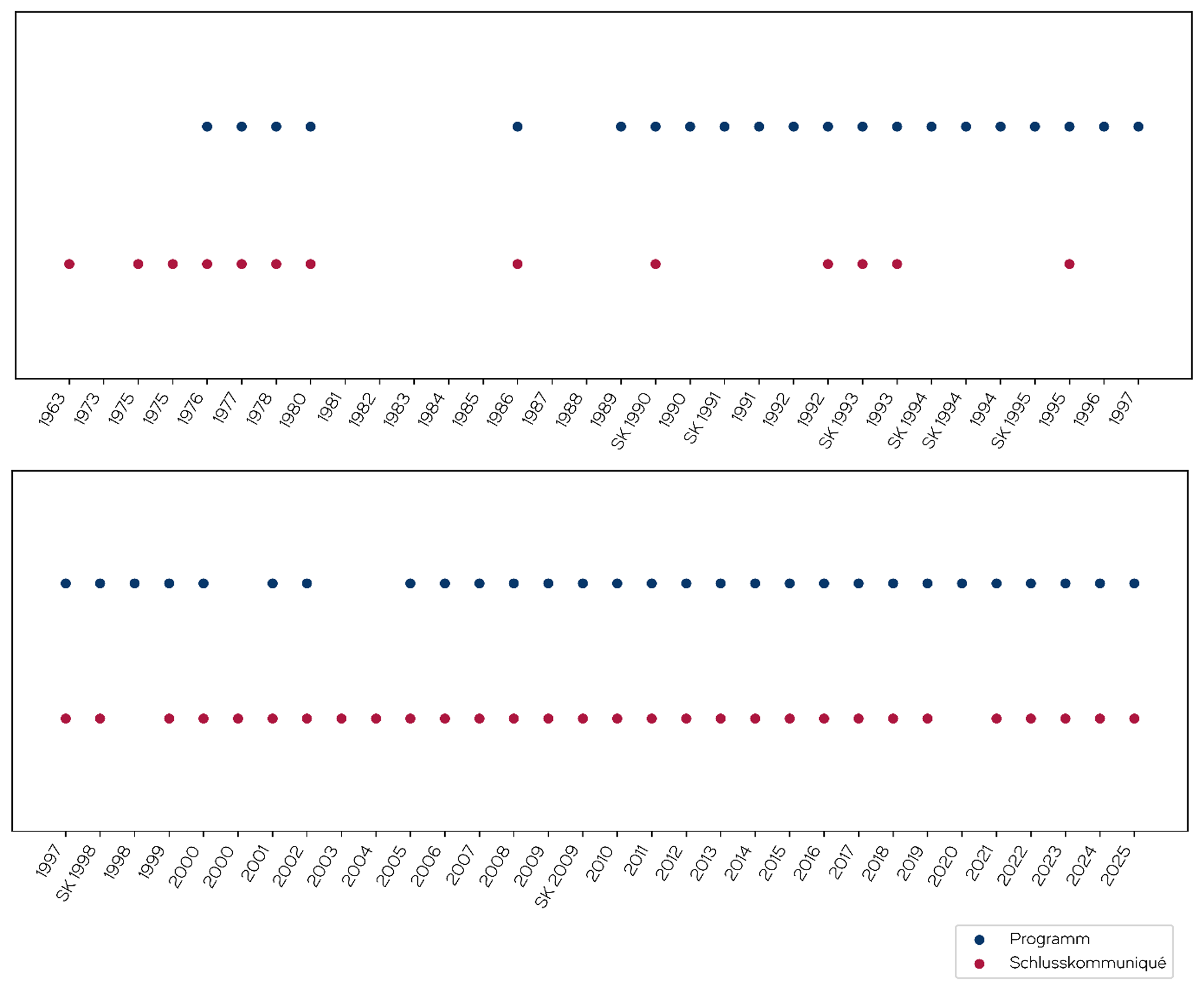
Note: Years in which a conference took place or was planned are shown (2020). SK stands for special conference.
Source: Own illustration based on the information in IPEX, loc. cit.
The functioning and conditions of the conferences were not discussed on an ongoing basis, but they were continuously discussed and, in the long term, formally formalised. As early as the 1980s, for example, a catalogue of parliamentary terminology was drawn up to improve mutual understanding and an exchange between the respective parliamentary libraries was encouraged. The logistical and financial challenges of the language regime have also been repeatedly discussed (for example in the Netherlands in 2004), precisely because the right to express oneself in one's mother tongue is regarded as a valuable asset.
Fundamental discussions on the procedures and responsibilities of the JPC-EU took place at the conferences in 1993, 1999, 2000, 2004 and 2008. The adoption of formal guidelines on the principles and internal procedures of the conference in 2000 can be counted among the organisational milestones. These were revised ten years later in Sweden (the so-called Stockholm Guidelines) and include the following rules similar to the rules of procedure:
The guidelines on the objectives and mechanisms of interparliamentary cooperation in the EU, which were adopted in 2004 and expanded in 2008, are also worth mentioning. In principle, formalised rules also go hand in hand with organisational professionalisation, as they reduce uncertainty (especially for new members and external players), make internal organisational rules more binding and relieve all participants of recurring negotiation processes on procedural and competence issues.[15]
A wide range of topics from different policy areas were discussed at the meetings (see Table 2) - this can also be seen as a contribution to the institutional intrinsic value. The diversity of topics is noteworthy in several respects: sometimes it is about political issues in the narrower sense, i.e. potentially contentious issues, and not just „feel-good“ issues or issues that all participants can readily agree on (such as stepping up the fight against organised crime). Issues with inherent potential for conflict were, for example, the austerity policy from 2010 or the migration policy in 2016, which were addressed even though they were highly controversial in many countries and in their national parliaments. Obviously, the PPC-EU did not and does not take the path of least resistance by only seeking and discussing issues with consensus potential. Rather, by taking up current, highly controversial issues, it has its finger on the pulse of the times.
Last but not least, it should be borne in mind that questions of parliamentary control always play a role in the matters discussed. These can be explicitly made an issue: For example, the improvement of the control of security and intelligence services by means of a database for the exchange of information between the relevant parliamentary committees was discussed in 2011. Indirectly, any interparliamentary exchange of information on a topic can contribute to the control function of parliaments. This is true because many European policy issues are negotiated outside the nation states by their governments. Interparliamentary networking through the PPK-EU is a targeted attempt to increase parliamentary capacities for action in Europe's multi-level democracy, which is characterised by executive power.
Table 2 below shows a selection of topics which illustrates that the conference deliberations have been touching on a wide range of policy areas for many decades. Issues that have attracted more public attention in recent years were also taken up at an early stage, such as immigration policy in 1993.
| Human rights / rule of law | Foreign policy | Security and defence policy |
| - European Convention on Human Rights (1977)
- Establishment of a European Ombudsperson (1994) |
- Dealing with the Yugoslavian crisis (1992)
- Cooperation with neighbouring EU countries (2019) |
- Parliaments' contribution to common defence (1993)
- Parliamentary oversight of the security and intelligence services (2011) |
| Economic policy | Social policy | Internal security |
| - Challenges in the internal market (1993)
- Overcoming the economic and financial crisis (2014) |
- Social challenges in the transition from a planned to a market economy (1992, 1996)
- Social cohesion and austerity policy (2013) |
- Fight against drugs/Europol (1993)
- Fight against organised crime (2000)
|
| Immigration policy | Environmental policy | Institutional policy (EU) |
| - Parliamentary contributions to migration policy in the EC (1993)
- Cooperation on and dealing with the consequences of migration (2016) |
- Progress on the Kyoto Protocol (2001)
- Challenges posed by climate change (2024) |
- Examination of bicameral parliament (1976)
- Participation of parliaments in institutional reforms in the EU (1991) |
The topic of institutional self-reflection can be identified as a „perennial issue“, both with regard to the (further) development of parliamentary cooperation within and outside Europe and with regard to general and current challenges for parliamentary institutions.
From the very beginning, the question of the development of the EC/EU was an important topic of discussion at the JPC-EU. As early as the inaugural conference in 1963, the claim was formulated that parliaments and parliamentary cooperation can and must contribute to the promotion of European awareness and generally to the progress of European integration. Over the years, discussions have centred on how national parliaments can participate in institutional reforms in Europe (conference in Germany 1994), how parliamentary cooperation can be improved following the Treaty of Amsterdam (Sweden 1998) or how better cooperation with other interparliamentary meetings in Europe can be achieved (Hungary 2005). The fundamental question of the role of parliaments in European integration is in any case an ongoing issue (e.g. Hungary 1996, Italy 2000). All of this is also reflected in the aforementioned guidelines on interparliamentary cooperation (2008) and the objectives of the PPK-EU set out in the Stockholm Guidelines.[16]
However, the conference's field of action also extends beyond the European framework of its own members. As early as the 1980s, for example, support for parliaments in countries undergoing democratic transformation processes was discussed (e.g. at the 1986 meeting in Portugal). This became even more of an issue when the third wave of democratisation hit Eastern Europe (France 1992). There were also corresponding activities beyond the European continent. To name one example: In 2000, there was a meeting with the parliamentary leaders of the Mercosur states, a South American economic alliance (Mercado Común del Sur / Common Market of the South) to discuss the parliamentary dimension of relations with the EU.
At the meeting in Rome in 1975, it was agreed that the aim was to address and study the challenges („modernisation problems“) of parliamentary democracy.[17] This also includes the endangered or perceived inadequate recognition and appreciation of parliamentary institutions among the population. The topic of „Parliament and the public“ was discussed as early as 1976, for example, and the danger of a growing gap between the representatives of the people and the citizens was pointed out, whereby one cause was initially identified in the difficult-to-understand modern legal language.
Over the years, a wide range of challenges have been discussed - from the relationship between parliamentary committees of enquiry and the judiciary (Belgium 1990) to the influence of the media on parliamentary processes (Poland 2012). Issues that are the subject of intense debate today were also discussed at an early stage, such as the extent to which parliaments should be a socio-structural reflection of society (Netherlands 1994), how social acceleration processes are causing the reaction speeds of politics, media and business to diverge and thus putting parliaments under pressure (Portugal 1999) or how the political participation of women can be strengthened (Portugal 2008).[18] The consequences of technological change also played a major role: the challenges posed by modern information and communication media were already discussed at the end of the 1990s (Portugal 1999). The topic of disinformation was repeatedly addressed in the context of the debate on democratic resilience (Denmark 2006, Austria 2019) and the digital transformation of the political public sphere was discussed as a threat and opportunity for parliamentary democracy (Germany 2021).
Finally, a standard issue of the PPC-EU that stems from the core content of parliamentary representation is the control function vis-à-vis the executive. It has played a role from the outset precisely because of the multi-level nature of European politics: if more and more problems are negotiated beyond the nation states by government representatives, but the negotiation results achieved are difficult to unravel at national level, parliaments have substantial disadvantages in the multi-level political process. It should also be borne in mind that the parliamentary leaders come together, which is usually characterised by role orientation or role expectations.[19] The latter are therefore better placed to represent the institutional self-interest of the parliaments. The latter is therefore in better hands with them than with the leadership groups of the government factions, which in parliamentary democracies sit in the same boat as the government they support in terms of function and in the eyes of the electorate.[20]
In this context, relations between the executive and legislative branches were also the subject of a number of early conferences (e.g. Germany 1976, Netherlands 1978), whereby the topics addressed here - parliamentary control, development of the EC/EU, recognition of the population - ultimately intertwine: Already at the meeting in Bonn in 1976, for example, it was emphasised that a balance between governments and parliaments was important in order to allow citizens to participate in the construction of the EC/EU. In the years that followed, specific topics discussed included the control function of parliaments in foreign policy (Spain 1989) and with regard to intelligence services (Belgium 2011), the development of parliamentary control following the Maastricht Treaty (United Kingdom 1995) and the role of parliaments in times of the coronavirus-related health emergency (Slovenia 2022).
Although only a few facets of the organisational development of the JPC-EU have been addressed here, it is clear that the conference has gained organisational stability and institutional value over time - and in this respect has undergone a development of institutionalisation that has probably gone largely unnoticed by the public. This is exemplified by the publication of programmes and final communiqués, the breadth of discussion topics (which include current and conflictual issues) as well as institutional self-reflection, which concerns the deepening of parliamentary cooperation in the EU and beyond.
On the one hand, this development should not be overestimated, as the PPK-EU is not relevant to decision-making in the institutional system of the European Union in the narrow sense, i.e. it is not a co-deciding actor. On the other hand, it should not be underestimated as an attempt to allow parliamentary institutions to come into their own and to strengthen them in the face of diverse challenges. The networking of information flows in the European multi-level system and the opportunity to learn from and with each other are not trivial side issues in democratic systems in which political action is subject to justification.
[1] Protocol No. 1 and No. 2 to the Treaty of Lisbon.
[2] An overview of the activities of the German parliamentary presidency in 2020 can be found here: Philipp Kubicki / Olaf Zehnpfund, Die parlamentarische Dimension der deutschen EU-Ratspräsidentschaft vom 1. Juli bis zum 31. Dezember 2020, Infobrief PE 6 - 3010 - 061/20 vom Deutschen Bundestag, Fachbereich Europa, Unterabteilung Europa, Berlin 2020; on the Czech Presidency of 2022, see Jana Tillová / Petr Kaniok, We Were In! The Czech Parliament and the EU Council Presidency of 2022, in: Journal of Contemporary European Studies, online first (22 September 2025), p. 13, based on an analytical approach by Petr Kaniok / Tereza Nováková, The Parliamentary Dimension of the Presidency of the Council of the EU: A Framework for Systematic Research, in: Journal of Legislative Studies, vol. 29 (2023), p. 1, pp. 96 - 112.
[3] See Klaus Pöhle, ‘Recent Developments at the Conference of Presidents of European Parliaments’, in: Zeitschrift für Parlamentsfragen, vol. 17 (1986), no. 1, pp. 82–93; Data Handbook on the History of the German Bundestages, Chapter 21.5, version dated 19 December 2022, https://www.bundestag.de/resource/blob/272990/c32139e7a5c5bc3f18d5807b749db1a2/Kapitel_21_05_parlamentspraesidentenkonferenz_ppk.pdf and IPEX, https://secure.ipex.eu/IPEXL-WEB/download/file/082dbcc54af19e11014af1d1d7770017/HistoryofEUSC_IPEX.pdf (both pages last accessed on 19 January 2026). IPEX (InterParliamentary EU Information Exchange) facilitates the mutual exchange of information between the European Parliament and national parliaments on matters relating to the European Union.
[4] Stefan Marschall has defined them as „transnational-multilateral actors composed of groups of members of national parliaments“ (ders., Transnationale Repräsentation in Parlamentarischen Versammlungen, Baden-Baden 2005, p. 22) and thus focussed on the nation-state level; however, they also exist at the sub-national level and with the simultaneous participation of national and sub-national parliaments, as the example of the Baltic Sea Parliamentary Conference illustrates.
[5] On the fundamental differentiation between presidential conferences and parliamentary assemblies, see Franziska Carstensen, Mehrebenenparlamentarismus? Das Beziehungsgeflecht deutscher Landesparlamente, in: Zeitschrift für Parlamentsfragen, 51st vol. (2020), H. 3, p. 534 - 553, p. 545 f.
[6] See Klaus Pöhle, loc. cit. (fn. 3); Datenhandbuch des Deutschen Bundestags, loc. cit. (fn. 3); IPEX, loc. cit. (fn. 3).
[7] The structure follows the IPEX platform, loc. cit.
[8] The Common Assembly of the European Community first met in 1958 and decided to change its name to the European Parliament in 1962; https://historicalarchives.europarl.europa.eu/de/home/fonds/parliamentary-activities/page.html (accessed on 19 January 2026).
[9] See Klaus Pöhle, loc. cit. (fn. 3), p. 86.
[10] IPEX, loc. cit. (fn 3).
[11] Two documents are only available in Spanish.
[12] Samuel P. Huntington, Political Order in Changing Societies, New Haven 1968, p. 12.
[13] According to Klaus Pöhle, op. cit. (fn. 3), p. 89, there were final communiqués in 1983 and 1985, but for unknown reasons these do not appear in the IPEX system.
[14] Kenneth Janda, Political Parties. A Crossnational Survey, New York 1980, p. 19.
[15] This has also been established many times in research for parliaments, parliamentary groups and parties: Cf. Wolfgang C. Müller / Ulrich Sieberer, Procedures and Rules in Legislatures, in: Shane Martin / Thomas Saalfeld / Kaare Strøm (eds.), The Oxford Handbook of Legislative Studies, New York 2014, pp. 311 - 331, p. 315; Danny Schindler / Theresa M. Pescht, Bundestagsfraktionen als professionalisierte demokratische Gebilde - Organisationsstrukturelle Entwicklungen seit 1949, in: Zeitschrift für Parlamentsfragen, 56th vol. (2025), p. 4, pp. 885 - 901; Susan E. Scarrow / Jamie M. Wright / Anika Gauja, Party Statutes and Party Institutionalisation, in: Party Politics, 29th vol. (2023), p. 2, pp. 217 - 228.
[16] These include the „promotion of [...] joint actions, including in relation to the forms and instruments of interparliamentary co-operation“ and the „supervision of the co-ordination of interparliamentary activities in the EU“ (Art. 2), Stockholm Guidelines (2010), Article 2, paragraph 2.
[17] See Klaus Pöhle, loc. cit. (fn. 3), p. 90.
[18] Taking account of the corresponding internal parliamentary change processes, a meeting of female parliament presidents on the topic of „female leadership“ took place for the first time in Spain in 2024 as part of the PPK-EU.
[19] Cristina Fasone already referred to problems that arise due to the different positions of the individual parliamentary presidents in their home parliaments, so that their room for manoeuvre is very differently structured. Cf. this, Ruling the (Dis-)Order of Interparliamentary Cooperation? The EU Speakers’ Conference, in: Nicola Lupo / this. (eds.), Interparliamentary Cooperation in the Composite European Constitution, Oxford / Portland 2016, p. 269 - 289, p. 274.
[20] Cf. also Klaus Pöhle, loc. cit. (fn. 3), p. 91.
 German German
  English